How MIS Increases Your Efficiency
Management Information Systems (MIS) is a powerful tool that helps organizations improve efficiency by providing accurate, timely, and structured information for decision-making.
What is MIS?
MIS (Management Information Systems) is a system that collects, processes, and stores data in an organized manner to support management decisions. It can be understood as a computerized database designed to generate continuous performance reports at every level of an organization.
MIS helps organizations analyze their processes and people effectively, enabling better planning and strategic decisions.
What MIS Does?
MIS provides regular and reliable information to managers, allowing them to make decisions based on data rather than assumptions.
It plays a crucial role in:
- Allocating resources efficiently
- Improving operational planning
- Supporting data-driven decision-making
How MIS Can Help?
MIS improves decision-making by delivering accurate and up-to-date information along with analytical insights. It ensures that businesses operate efficiently by using reliable data.
Organizations must ensure that their MIS system is compatible with existing data formats and includes necessary features for smooth operations.
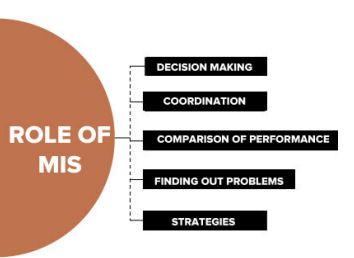
Benefits of MIS Implementation
- Quality and well-informed decision making
- Better coordination within management
- Proper comparison of performance
- Effective identification of problems
- Formulation and implementation of strategies
Dimensions of MIS
MIS consists of four major components:
1. Transaction Processing System (TPS)
Processes routine business transactions such as payroll, order processing, and invoicing.
2. Management Support Systems (MSS)
Stores and organizes data, enabling report generation and data analysis for planning.
3. Decision Support Systems (DSS)
Analyzes business data to assist managers in decision-making and forecasting.
4. Expert Systems
Uses artificial intelligence to provide insights and simulate expert-level decision-making.
About MIS and Its Usage
Modern MIS systems use cloud technology and provide real-time monitoring of data. They help track productivity, analyze trends, and respond to business queries efficiently.
Depending on the size of the organization, MIS may be managed by a dedicated IT team. It is accessible not only to decision-makers but also to employees for better coordination and performance tracking.
Conclusion
Implementing MIS in an organization enhances efficiency, improves decision-making, and ensures better control over operations. It is an essential tool for modern businesses aiming for growth and sustainability.