Understanding and Managing Investment Risk
As an investor, managing risk is a crucial aspect of achieving your financial goals. Risk is an inherent part of investing. Everyone faces financial risk, whether they invest or not. Not investing your money has its own set of risks, and so does investing. No investment is without risk.
Even if you hire the best financial advisers and follow their guidance, risk still exists. To build wealth over time, investors must accept a certain level of risk. Keeping money in low-risk instruments such as savings accounts or fixed deposits may feel safe, but it can result in loss of purchasing power over time due to inflation and rising costs.
Walk Before You Run
There are two main types of investors at opposite ends of the risk spectrum:
- Risk-averse investors who are afraid of losing money, often due to past negative experiences.
- Risk-takers who pursue high returns and may take aggressive investment decisions.
With the growing variety of financial products available today, investors—especially risk-takers—have more options than ever.
However, a common mistake occurs when low-risk investors suddenly shift to high-risk investments after limited research or exposure to financial content. This often leads to poor outcomes and financial losses.
Instead of making sudden leaps, investors should adopt a gradual approach. Move step-by-step from low-risk to higher-risk investments. This helps in understanding how risk evolves at each level and allows better decision-making.
Key Insight:
New investors should avoid making large jumps in their investment journey. Controlled and informed progression is essential.
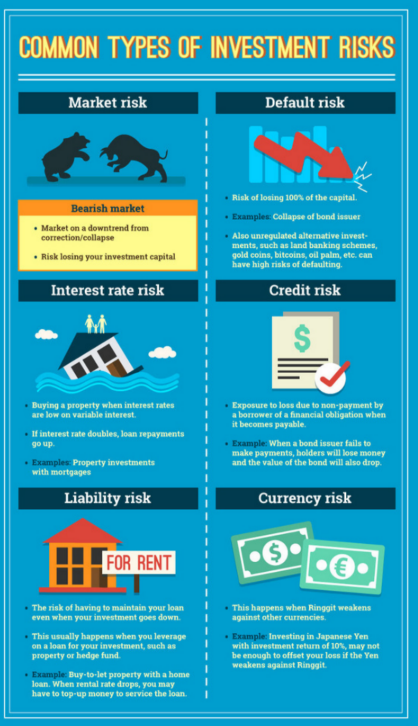
Understanding Investment Risk Types
The first step in managing risk is understanding the types of risks involved. Below are some common investment risks:
1. Market Risk
- Occurs when markets decline or fluctuate
- Can lead to loss of investment value
2. Default Risk
- Risk of losing capital if the issuer fails to meet obligations
- Common in unregulated or high-risk investments
3. Interest Rate Risk
- Changes in interest rates affect investments like loans or real estate
- Rising rates can increase repayment burdens
4. Credit Risk
- Risk of non-payment by borrowers
- Can impact bondholders and lenders
5. Liability Risk
- Arises when leveraged investments (loans) must still be serviced despite declining returns
- Common in real estate investments
6. Currency Risk
- Occurs when foreign investments lose value due to exchange rate fluctuations
Final Thoughts
Many investors find risk management complex or uninteresting, but ignoring it can lead to serious consequences. Every investment carries some level of risk, and it is the investor’s responsibility to evaluate whether the potential returns justify that risk.
Ask yourself:
- What type of investor are you?
- Can you tolerate market fluctuations?
- Do you prefer stability or growth?
As famously stated, understanding both your goals and the risks involved is essential to achieving financial success.